Justitia: female and blind
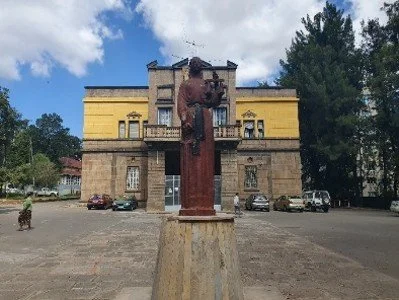
Going back to an old version of my doctoral thesis recently, I came across something I had almost forgotten.
On the very first page was a photograph I took of Justitia on the campus of Addis Ababa University in January 2020. Next to it, I had written a short note to myself: “Justitia: female and blind.”
At the time, it was simply an observation. Looking back now, it feels remarkably connected to the questions that would eventually run through my research.
During my research, I came across the symbolism of Justitia: the irony of Justice being a woman when society historically has denied women legal personality, capacity and participation in legal and political fields.
And then there is the blindfold. Blindness is conventionally understood as a symbol of neutrality and impartiality: justice does not see wealth, gender, or power. But blindness can also mean something else. It can represent a failure to see or to recognise certain harms as legally relevant, or to see the structures through which those harms are (re)produced.
That meanings resonate deeply with my doctoral research on gender-based poverty in urban areas and human rights.
Justitia may aspire to neutrality, to be blind to gender, socio-economic status, age or race, while the realities in which people live are anything but neutral. Social-economic structures shape who has access to housing, land, services, security and participation in urban life, and they shape who experiences poverty and how it is experienced.
When the law itself is blind to these inequalities, Justitia needs to see.
That is a case I began to make in my research and one I now carry into my work at TRANSVERSAL.
written by Kelly Bishop, 12.08.2026
